Clearing Invasive Species for Carbon Credits
Learn how invasive biomass such as Prosopis juliflora can be converted into biochar, supporting land restoration, carbon removal, and community income.
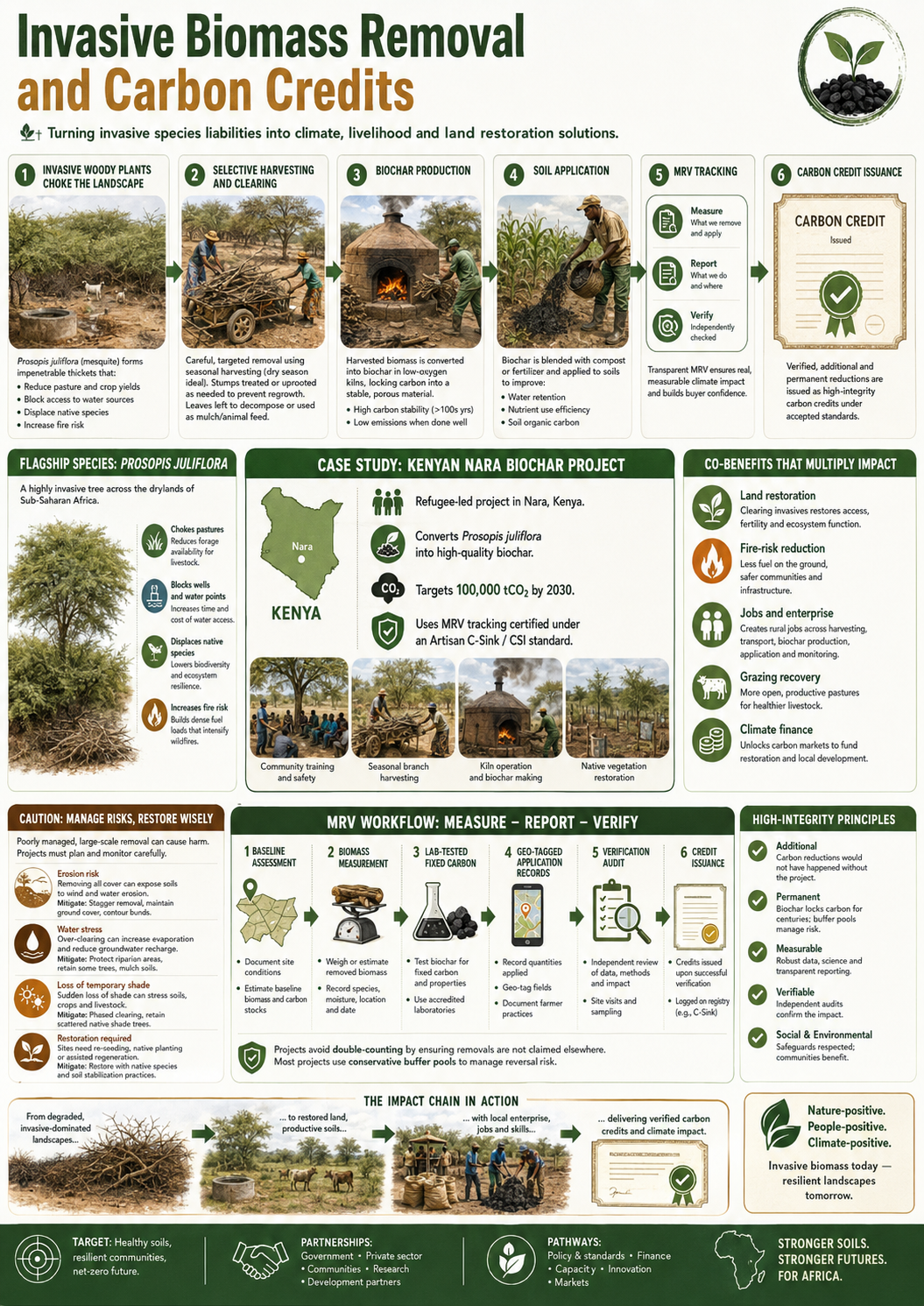
Invasive alien plants are usually treated as a land management problem. They spread aggressively, displace indigenous vegetation, reduce grazing potential, alter water systems, and make land less productive. But when managed properly, invasive biomass can also become a climate opportunity. By converting invasive woody material into biochar, communities can remove problematic vegetation, restore land, create local income, and generate measurable carbon removals.
A strong example is Prosopis juliflora, also known in Kenya as mathenge. It was introduced into parts of East Africa for dryland rehabilitation, fuelwood, and erosion control, but later became highly invasive. In Kenya, Prosopis juliflora was declared a noxious weed in 2008 under the Suppression of Noxious Weeds Act. Research and field reports describe how it can form dense thickets, displace grazing land, restrict access, and reduce the availability of native fodder plants.
The Biochar Model: Turning a Problem into an Opportunity
The biochar model changes the economics of clearing. Instead of cutting and burning invasive material, or leaving it to decompose, the woody biomass is harvested, dried, processed, and pyrolysed. Pyrolysis converts part of the biomass carbon into a more stable form that can be stored in soil, concrete, or other durable applications. This creates a potential carbon removal pathway rather than a simple land-clearing exercise.
In Kenya, emerging projects are already applying this concept. The Nara & Criou Biochar Project in Turkana is a refugee-led carbon project that turns encroaching bush into biochar while applying land restoration and agroforestry techniques. Each tonne of carbon removed is tracked and verified through an MRV platform, creating credits and new income streams for participating refugees and local communities.
What Carbon Certification Requires
For carbon credit purposes, the key issue is proof. A project must show:
- Where the biomass came from and why its removal is beneficial
- How much material was processed and what technology was used
- How much biochar was produced and what its carbon content and stability are
- Where the biochar was finally placed and stored
Certification systems generally require batch traceability, production records, sampling, laboratory analysis, and periodic verification. Under the European Biochar Certificate, production batches are registered and linked to feedstock, production conditions, and biochar quality.
Ecological Responsibility: Beyond Simple Biomass Extraction
This creates a powerful but disciplined project model. The invasive species must not be deliberately propagated. The project must avoid creating a perverse incentive to maintain or expand the invasion. The harvesting must be done in a way that supports ecological restoration, not merely biomass extraction. Cleared areas should ideally be followed by reseeding, managed grazing, agroforestry, or indigenous vegetation recovery.
There are also technical risks. Wet feedstock produces poorer carbon and emissions outcomes. Contaminated material can compromise biochar quality. Poorly controlled kilns can create smoke, methane, carbon monoxide, or inconsistent char. The carbon project must therefore include drying protocols, kiln operating procedures, temperature records, biochar sampling, storage records, and final use records.
When done properly, invasive biomass-to-biochar projects can align three objectives: ecological restoration, community livelihoods, and durable carbon removal. The landowner or community gains a reason to clear invasive biomass. The carbon buyer gains a measurable removal credit. The local ecosystem gains a chance to recover.
The best projects will be those that treat carbon credits as the financial engine, not the only goal. The broader impact comes from combining carbon removal with restored grazing, improved soil, local jobs, reduced fire risk, and long-term land productivity.
References
- BioNET-EAFRINET, Prosopis juliflora factsheet and legislation in Kenya.
- A Rocha Kenya, The invasive species Prosopis juliflora and its spread in Kenya.
- Planboo, Nara & Criou Biochar Project, Kenya.
- European Biochar Certificate, Guidelines for a Sustainable Production of Biochar, 2024.
- Carbon Standards, Production of Biochar: ongoing production and batch certification.