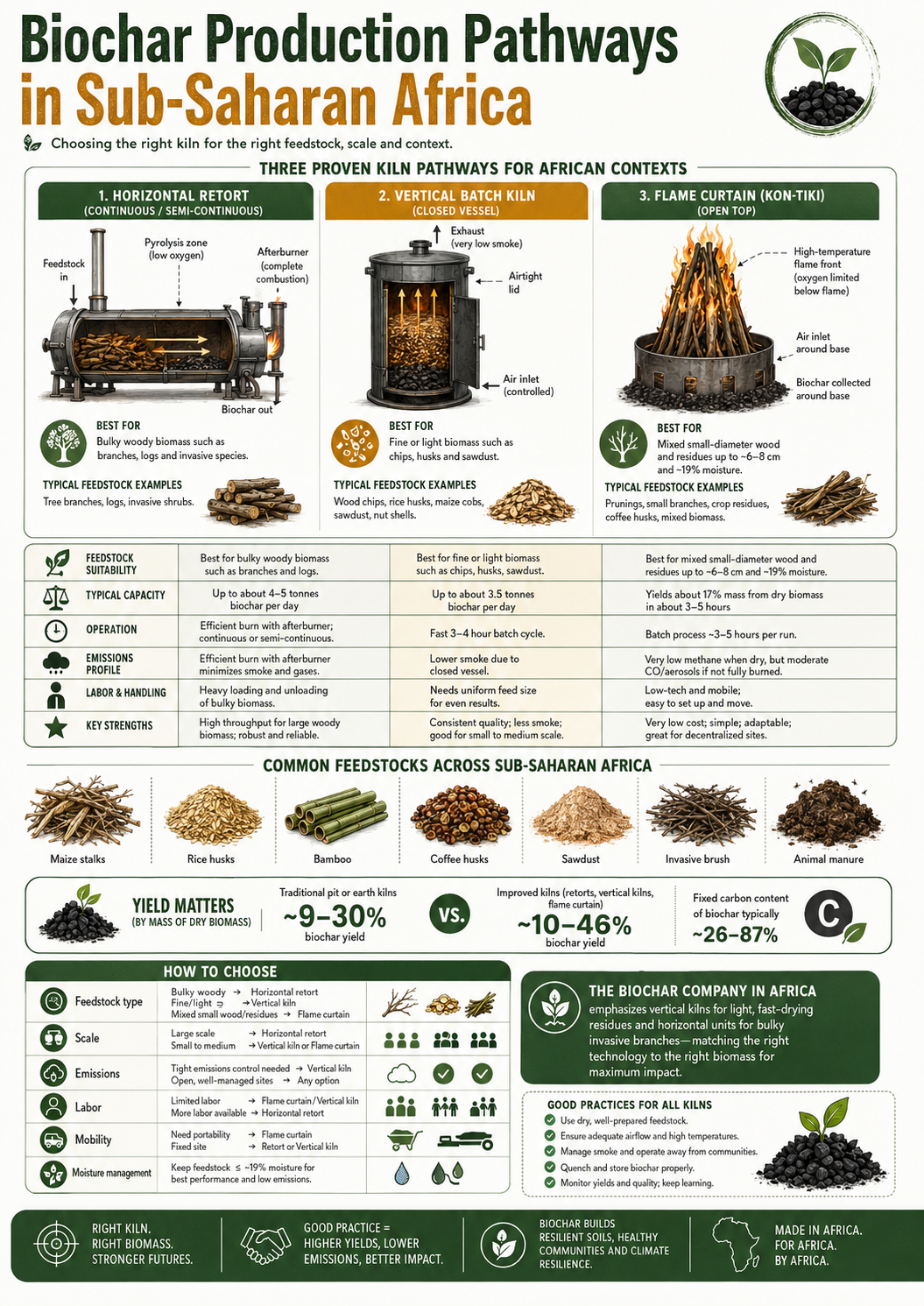
Horizontal vs Vertical Kilns: A Comparison
An in-depth guide on choosing the right pyrolysis kiln based on your local feedstock, whether you have light agricultural waste or heavy timber.
The choice between a horizontal and a vertical kiln is not simply a matter of preference. It is a practical decision that depends on the feedstock type, available labour, site conditions, intended scale, and what the final biochar needs to achieve. Getting this choice right early can avoid costly retrofitting, downtime, or poor-quality char.
Understanding the Difference
Both horizontal and vertical kilns are types of batch retort kilns. In a retort design, the biomass is loaded into a sealed chamber and heated from the outside. Volatile gases released during pyrolysis are drawn off and combusted, providing heat and reducing emissions. The key difference between horizontal and vertical kilns lies in how the biomass is loaded, how heat moves through it, and how the finished biochar is removed.
A horizontal kiln is oriented lengthways. Biomass is loaded from one or both ends and stacked along the length of the chamber. This design is well suited to long or bulky materials such as branches, timber offcuts, logs, or stripped invasive tree stems. It allows for manual loading without cutting everything to short uniform lengths, and it makes it easier to inspect and manage the load during the process. Once complete, the ends can be opened and the char raked or tipped out.
A vertical kiln generally has a smaller footprint and can be efficient where feedstock is cut to consistent lengths or chipped to suitable dimensions. Vertical designs can suit compact sites and may offer good heat containment, but they can be more difficult to unload, especially if the char bridges, compacts, or does not discharge cleanly. For very long or heavy wood, vertical loading can also create safety and handling issues.
Performance Comparison
| Factor | Horizontal Kiln | Vertical Kiln |
|---|---|---|
| Best feedstock | Bulky, woody, variable length (branches, logs, invasive stems) | Uniform, pre-cut chips, husks, small-diameter material |
| Site footprint | Larger horizontal space required | Smaller footprint, suits compact sites |
| Loading | Easier with irregular material | Requires uniform cut lengths; top-load safety considerations |
| Unloading | End-access makes char removal straightforward | Can be difficult if char bridges or compacts |
| Batch cycle | 5–8 hours typical | 3–6 hours for uniform material |
| Yield efficiency | 10–46% (varies by feedstock and operation) | 10–46% (varies by feedstock and operation) |
Why Feedstock Preparation is Critical
The distinction matters because feedstock preparation is one of the biggest drivers of kiln performance. A review of small-scale biochar kilns found that kiln selection is influenced by both cost and performance, and that different kiln types can produce widely varying yields and fixed-carbon contents. The review reported yield efficiencies ranging from 10% to 46% and biochar fixed carbon contents from 26% to 87%, depending on kiln design and operating conditions.
Moisture content is equally important. Research on flame curtain kilns found almost no methane emissions when dry feedstock below 15% moisture was used, but very high methane emissions when wet feedstock above 40% moisture was used. Although this study focused on flame curtain kilns, the principle is directly relevant to batch kiln operation: wet biomass wastes heat, extends cycle time, increases emissions risk, and reduces process control.
Carbon Certification Considerations
For carbon-credit projects, the choice between horizontal and vertical is less important than evidence of controlled production. Certification-focused projects need consistent feedstock, controlled temperature, batch records, sampling, and traceability. The European Biochar Certificate requires each production batch to be registered and linked to feedstock, production conditions, and biochar quality. It also requires the declared pyrolysis temperature to remain within defined limits during production.
Choose a horizontal kiln when the biomass is heavy, irregular, long, woody, or manually handled.
Choose a vertical kiln when the feedstock is uniform, the site is space-constrained, and loading/unloading can be safely mechanised or standardised.
For most community-scale biochar projects using branches, orchard residues, alien invasive trees, or mixed woody biomass, a horizontal retort kiln is often the more forgiving and practical starting point. For more standardised production, a vertical kiln can be efficient, but it requires tighter discipline in feedstock sizing and operating procedure.
The best kiln is therefore not the biggest or the cheapest. It is the kiln that matches the feedstock, keeps emissions low, produces consistent biochar, can be operated safely, and generates the records required for certification or carbon-credit verification.
References
- Namaswa et al., Emerging trends in appropriate kiln designs for small-scale biochar production in low- to middle-income countries, Cleaner Engineering and Technology, 2023.
- Cornelissen et al., Flame curtain kilns produce biochar from dry biomass with minimal methane emissions, Science of the Total Environment, 2023.
- European Biochar Certificate, Guidelines for a Sustainable Production of Biochar, 2024.
- Carbon Standards, Production of Biochar: batch certification and sampling.