The Role of Indigenous Microbes in Soil Health
Discover how indigenous microbial organisms and biochar work together to improve soil structure, water retention, nutrient cycling, and resilience in dryland soils.
Healthy soil is not simply a growing medium. It is a living system made up of minerals, organic matter, water, air, roots, fungi, bacteria, protozoa, and countless microscopic interactions. In dry or degraded soils, this biology is often weakened by heat, compaction, low organic matter, salinity, chemical overuse, or poor water retention. That is where the combination of biochar and indigenous microbial organisms, often referred to as IMO, becomes powerful.
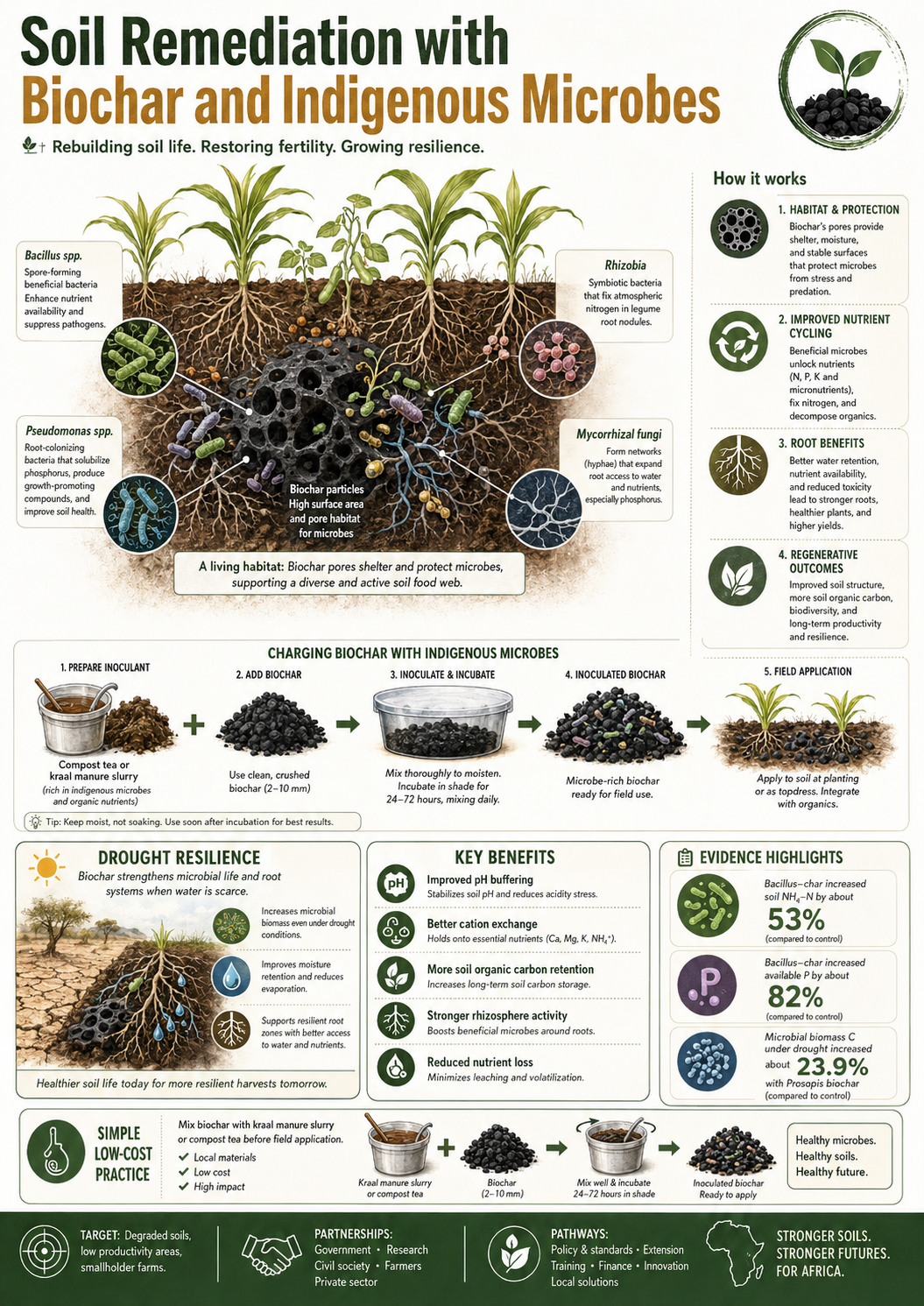
Biochar is a carbon-rich material produced by heating biomass in a low-oxygen environment. When correctly made and applied, it can improve soil structure, increase porosity, help retain nutrients, support water-holding capacity, and provide protected microhabitats for soil organisms. Reviews of biochar and soil biology show that biochar can support microbial diversity by improving the physical and chemical conditions in which microbes live. Its porous structure can act like a "microbial hotel", giving beneficial organisms a protected surface on which to colonise.
Indigenous microbes are important because they are already adapted to the local environment. In arid or semi-arid regions, locally adapted microbes may be better suited to heat, water stress, local soil pH, and the existing plant community than imported microbial products. When these organisms are multiplied through composting, fermentation, leaf mould extraction, or carefully prepared IMO systems, they can help restore biological function in tired soils.
The practical value of combining biochar with indigenous microbes is that biochar provides structure, while microbes provide function. Biochar can retain moisture and nutrients, but it is not a complete biological solution on its own. Microbes help cycle nutrients, decompose organic matter, support root development, and build soil aggregates. In this way, biochar acts as the stable carbon scaffold, while indigenous microbes bring the soil back to life.
This combination is particularly relevant in dryland agriculture and drought-prone landscapes. A meta-analysis of 939 observations found that biochar can improve soil water retention, with effects varying by soil texture. Coarse-textured soils showed particularly strong improvements in field capacity and available water capacity, while the mechanisms differed in medium and fine-textured soils.
How to Apply Biochar with Indigenous Microbes
For farmers and landowners, the most effective approach is usually not to apply raw biochar directly into the soil. Fresh biochar can temporarily absorb nutrients and may not yet be biologically active. A better approach is to "charge" or inoculate it before application. This can be done by blending biochar with compost, manure, worm castings, compost tea, microbial extracts, or locally collected IMO preparations. Once charged, the biochar is more likely to support soil life rather than temporarily competing with plants for available nutrients.
The application rate should be conservative at first. Biochar quality varies significantly depending on feedstock and pyrolysis temperature. Certification guidelines such as the European Biochar Certificate require declaration of organic carbon content and use the molar H/Corg ratio as an indicator of carbonisation and stability. For soil use, this means that not all black carbon is equal. Poorly made char, contaminated feedstock, high ash content, excessive pH, or high salinity can damage soil instead of improving it.
A Practical Five-Step Soil Health Programme
A practical soil-health programme should follow five steps:
- Test the soil — understand its baseline chemistry, texture, and biology
- Test or understand the biochar — know its carbon content, pH, and origin
- Charge the biochar biologically — inoculate with compost, manure, or IMO cultures
- Apply in small trial areas first — monitor response before scaling
- Monitor plant response — look for improved water infiltration, root growth, and plant colour
The signs of success are improved water infiltration, better root growth, stronger plant colour, reduced irrigation stress, more earthworm activity, and improved soil crumb structure.
The real opportunity is not simply "adding biochar" or "adding microbes". The opportunity is to rebuild the soil ecosystem. Biochar provides a durable carbon framework, while indigenous microbes restore local biological intelligence. Together, they can help create more resilient soils, especially in areas facing drought, nutrient depletion, and climate stress.
References
- Bolan et al., Biochar modulating soil biological health: A review, Science of the Total Environment, 2024.
- Wei et al., Drivers of biochar-mediated improvement of soil water retention capacity based on soil texture: A meta-analysis, Geoderma, 2023.
- Deng et al., Biochar-based Bacillus subtilis inoculants promote plant growth, Journal of Environmental Management, 2025.
- European Biochar Certificate, Guidelines for a Sustainable Production of Biochar, Version 10.4, 2024.